Start With the Lane, Not the Container
A packaging choice is a response to a specific thermal challenge, so the challenge has to be defined first. Four properties of the lane set the requirement.
-
Duration: How long the product is in transit, door to door, including the dwell time nobody puts on the schedule: tarmac waits, customs holds, weekend layovers.
-
Ambient exposure. The real temperatures along the route, leg by leg, in the season the shipment actually moves. A route that averages comfortably can still spike hard during one handoff.
-
Product range and tolerance. The required range, whether +2°C to +8°C, controlled room temperature, or frozen, and how much excursion the product's stability data allows.
-
Handling and route complexity. The number of transfer points, the modes involved, and how much the shipment will be moved between controlled environments, each handoff being a place protection can lapse.
Define those four, and the packaging requirement stops being a matter of preference and becomes a specification the lane itself has written.
The Three Kinds of System
Temperature-controlled packaging falls into three broad categories, and each answers a different kind of lane.
Passive systems hold temperature through insulation and a pre-set coolant such as gel packs, phase-change material, or dry ice, with no power and no moving parts. They are light, relatively low cost, and free of mechanical failure risk, which makes them well suited to shorter and mid-length lanes with predictable conditions. The trade-offs: many need careful pre-conditioning and correct assembly, their duration is capped by the coolant, and performance can degrade in extreme external temperatures. A passive system depends on the people packing it following the procedure exactly.
Active systems use powered heating and cooling, usually battery and mains, to hold a set temperature regardless of ambient conditions. They maintain range over long durations, need no pre-conditioning, and record their own performance, which suits long-haul, high-value, or high-risk lanes. The trade-offs: high tare weight, higher cost and a lease-and-return model, dependence on charging and power during transit, and limits on which aircraft can carry them.
Hybrid systems combine passive insulation with phase-change materials to extend autonomy without the full weight and power dependence of an active unit. They aim for the middle: longer protection than a simple passive box, less operational overhead than a powered container.
Match the System to the Risk
The categories map onto lanes by risk, not by prestige. A short, low-risk lane with stable ambient conditions rarely justifies the weight, cost, and logistics of an active container; a well-qualified passive system does the job at a fraction of the overhead. A long, multi-leg lane through volatile conditions, carrying high-value product with a tight excursion budget, is where an active or hybrid system earns its cost. The mistake in both directions is the same: choosing by habit when the lane's risk profile should decide. Over-packaging a simple lane wastes money on every shipment; under-packaging a hard one spends the savings on the first excursion, with product on top.
Qualification Is Not Optional
Whatever the category, a packaging system is only as good as its qualification for the intended use. A container that passed a laboratory profile is not automatically fit for a specific lane's real duration and ambient extremes. Good practice ties the choice to a documented qualification and a risk assessment for the route it will run, so the evidence exists that this system holds this product's range over this lane's conditions. A packaging decision without that evidence is an assumption, and an auditor will treat it as one.
Revisit the Choice When the Lane Changes
A packaging choice is correct for a lane as the lane is today. Routes change, seasons turn, carriers swap handlers, and a system that fit last year can quietly stop fitting. The choice should be revisited when the lane's risk profile shifts, on the same logic that governs the original decision: match the system to the conditions the shipment will actually meet.
How Validaide Supports the Decision
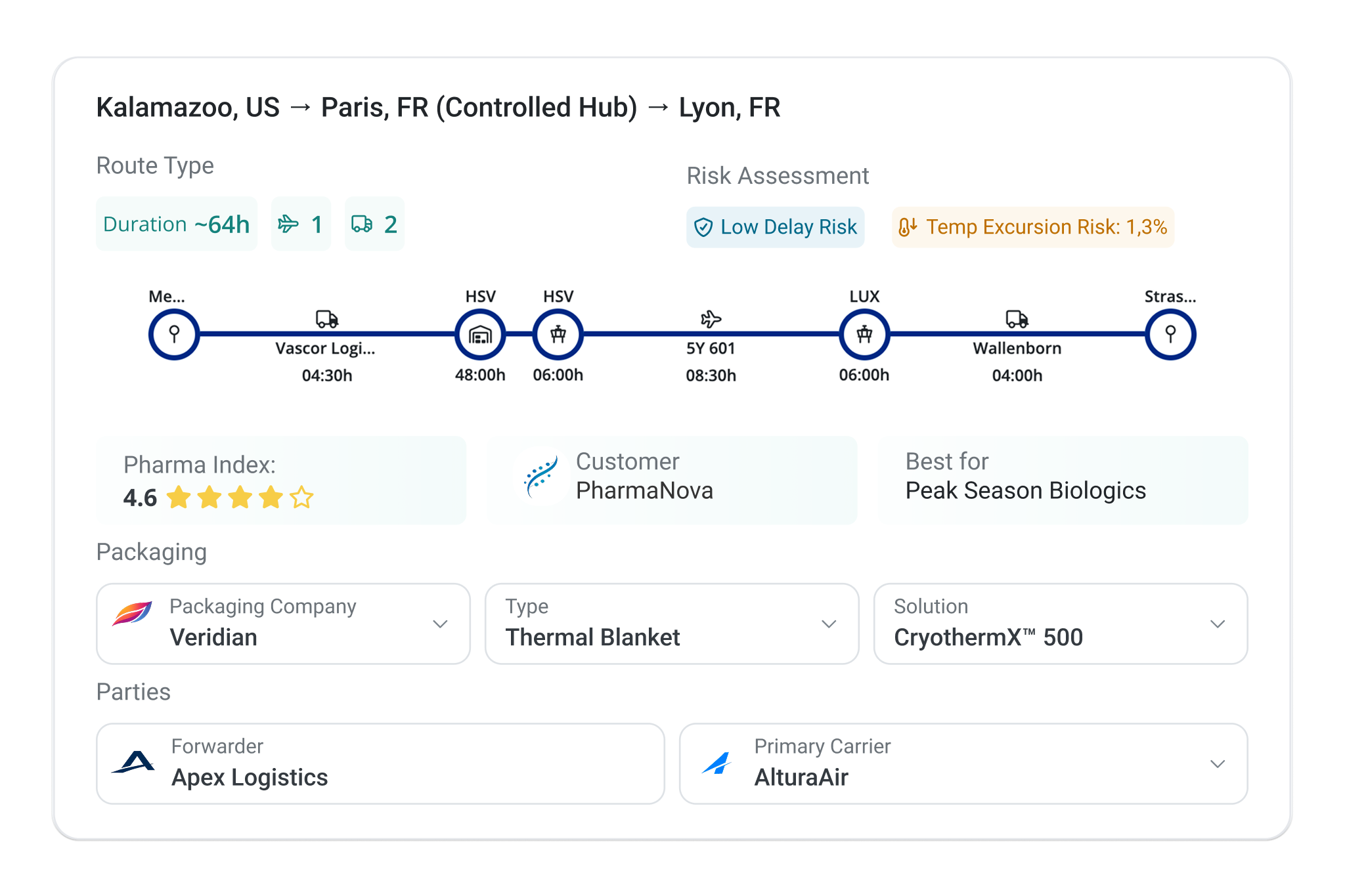
Validaide does not sell packaging, and it is not trying to point you at one system. What it provides is the lane risk profile the decision should start from. The Dynamic Pharma Index scores each lane on temperature exposure and route duration and complexity, among other factors, and scores the protection a given packaging solution provides against that exposure, so the two are weighed together, in one judgment. That connects a lane's real risk to the packaging class and monitoring it calls for, and flags the lane for a fresh look when conditions change. The packaging choice stays yours. Validaide's role is to make sure the lane's real risk drives the choice.
References