Supplier qualification gives a duration under test conditions. The lane risk assessment scores the route against a packaging category. The question Quality has to answer sits between them: how will this packaging behave on this route, in the month it flies?
Packaging Simulation answers it, option by option, before the first shipment.
What changes for Quality
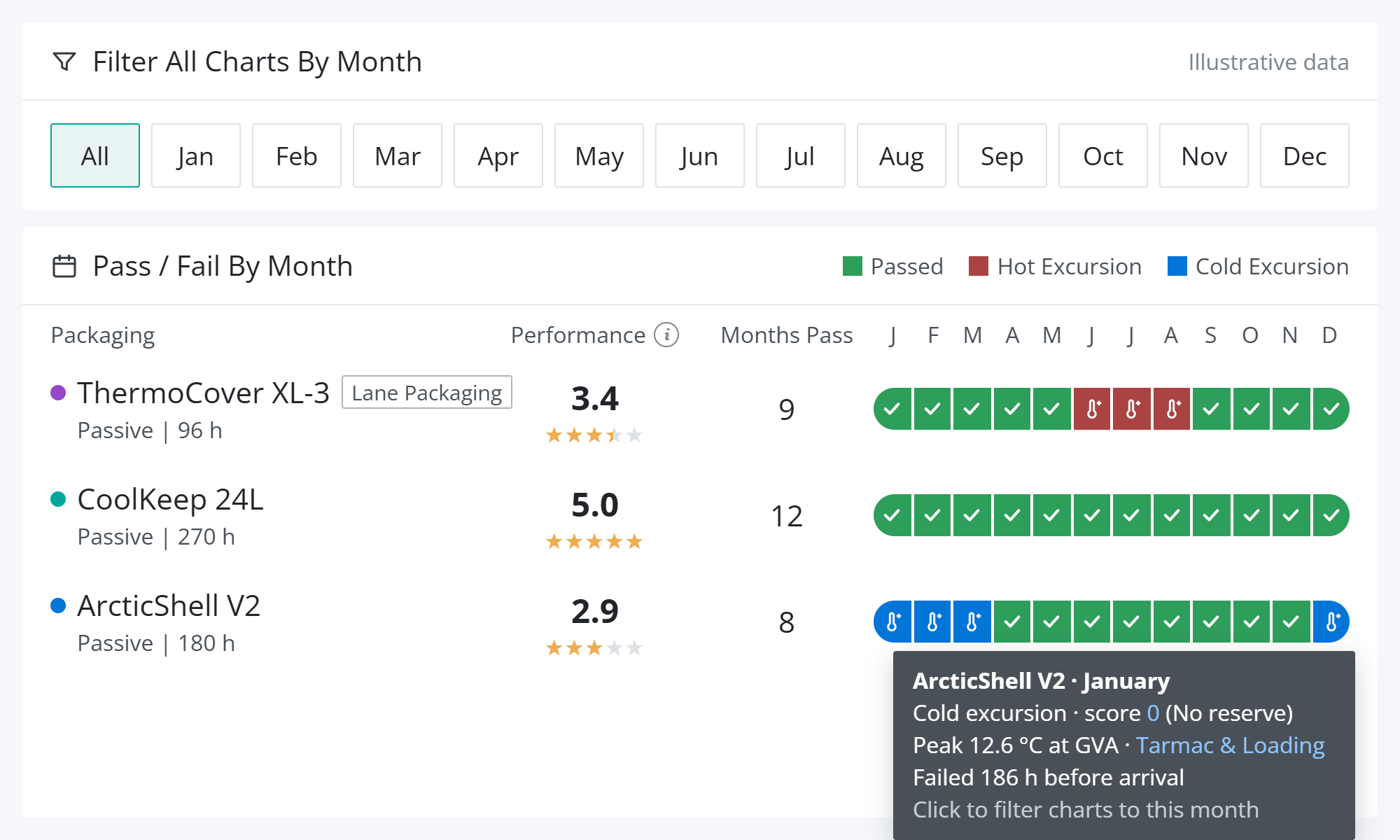
The approval file gets evidence about the route. For each option, you see which months it passes, which it fails, and how many hours of reserve time it leaves on arrival under cold, typical, and hot conditions. Packaging that holds in January can fall short in July. The result shows it before the shipment does.
Each option gets a Packaging Performance score from 0 to 5 based on its reserve time on arrival, so a comparison of up to three options reads like for like. The lane's Pharma Index stays as it is.
The modeled result sits in the lane record, so an auditor, or a colleague who picks the lane up later, can see what was chosen and why. It helps reduce the risk of excursions, and it makes packaging decisions faster to make and easier to defend.
Why you can trust the result
A modeled result is only as good as the model behind it.
-
Real tests: All packaging available in Packaging Simulation is tested the same way in the lab first.
-
Run to excursion: Real units are run to excursion on constant profiles at −10 °C, +30 °C, and +45 °C, with at least three hot and three cold runs and nine or more sensors.
-
Calibrated to the first breach. The model anchors to the earliest sensor breach, or a lower acceptance limit, so it errs on the side of risk.
-
Source on record. The report, version, and date travel with each model, and a second reviewer checks every fit before release.
How it works in practice
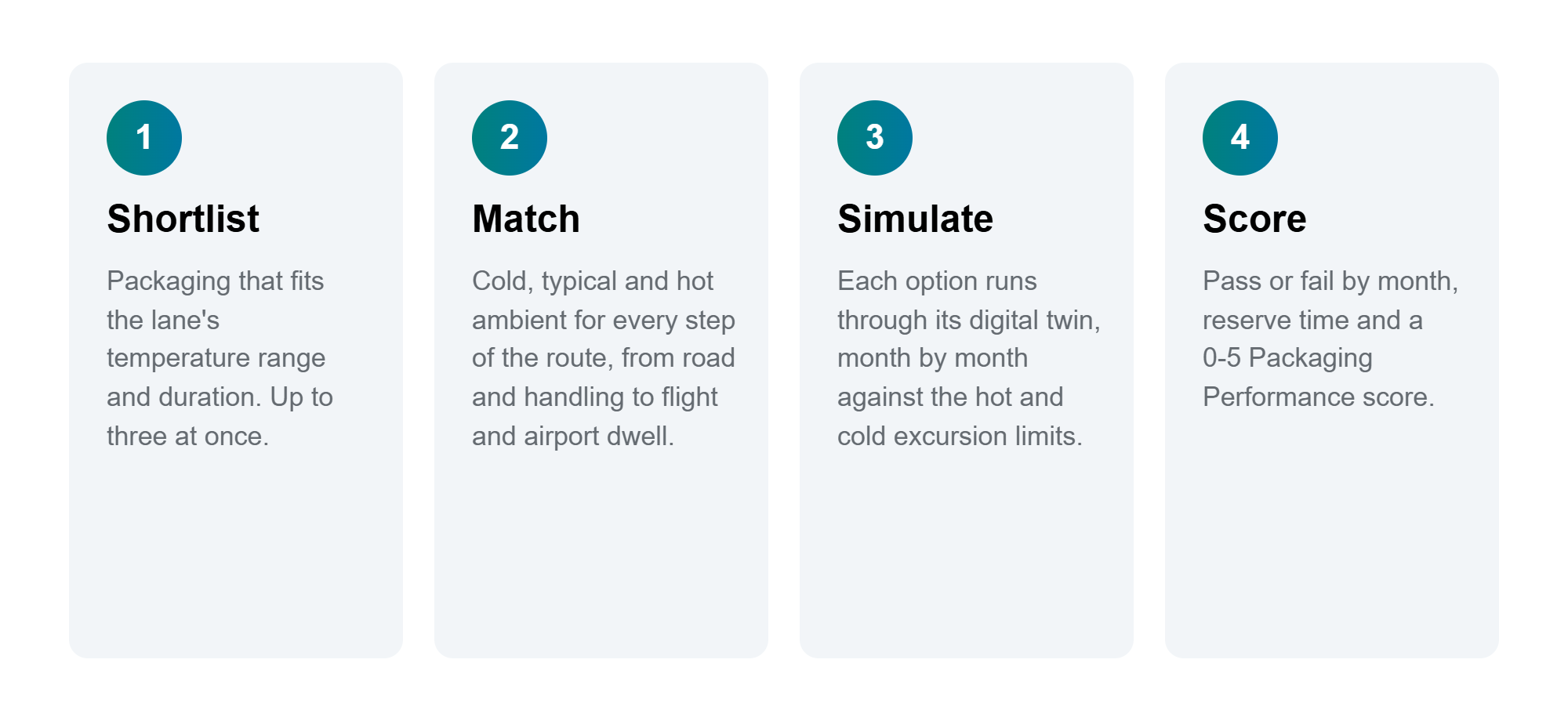
Four steps, all inside the lane you already work in.
- Shortlist. Open the lane. Validaide narrows your catalog to packaging that fits the lane's booked temperature range and qualifying duration, up to three options at a time.
- Match. Each option meets the lane's own conditions: cold, typical, and hot ambient temperatures for every step of the route, based on 2020 to 2024 data.
- Simulate. Each option runs through its digital twin, month by month. Excursions are graded minor, major, or critical.
- Score. You see pass or fail by month, reserve time on arrival, and a Packaging Performance score from 0 to 5. Approve the lane with the result already in the lane record, next to the lane risk assessment.
Packaging Simulation supports all packaging types. There's a validated library ready to simulate today, and where you use something outside it, send us the specification and we'll model it.
Where simulation fits with validation
Regulators point to the lane. The PIC/S Guide to Good Distribution Practice asks for risk assessment of delivery routes (9.2.5) and packaging selection that reflects anticipated external temperature extremes (9.3.2). PIC/S PI 006-4 asks manufacturers to assess known variables such as weather and to verify the transport route before use (section 6.1).
Simulation gives that lane-level assessment a documented, versioned basis, with audit-ready evidence for the lane decision. It supports qualification and performance qualification work and informs the decision, which stays with Quality.
See it on your lane
The approval then carries evidence for the route as well as the packaging, filed in the lane record where the next review will find it.
Packaging Simulation is in beta and rolling out in phases. Request a demo to see it on one of your lanes.
References