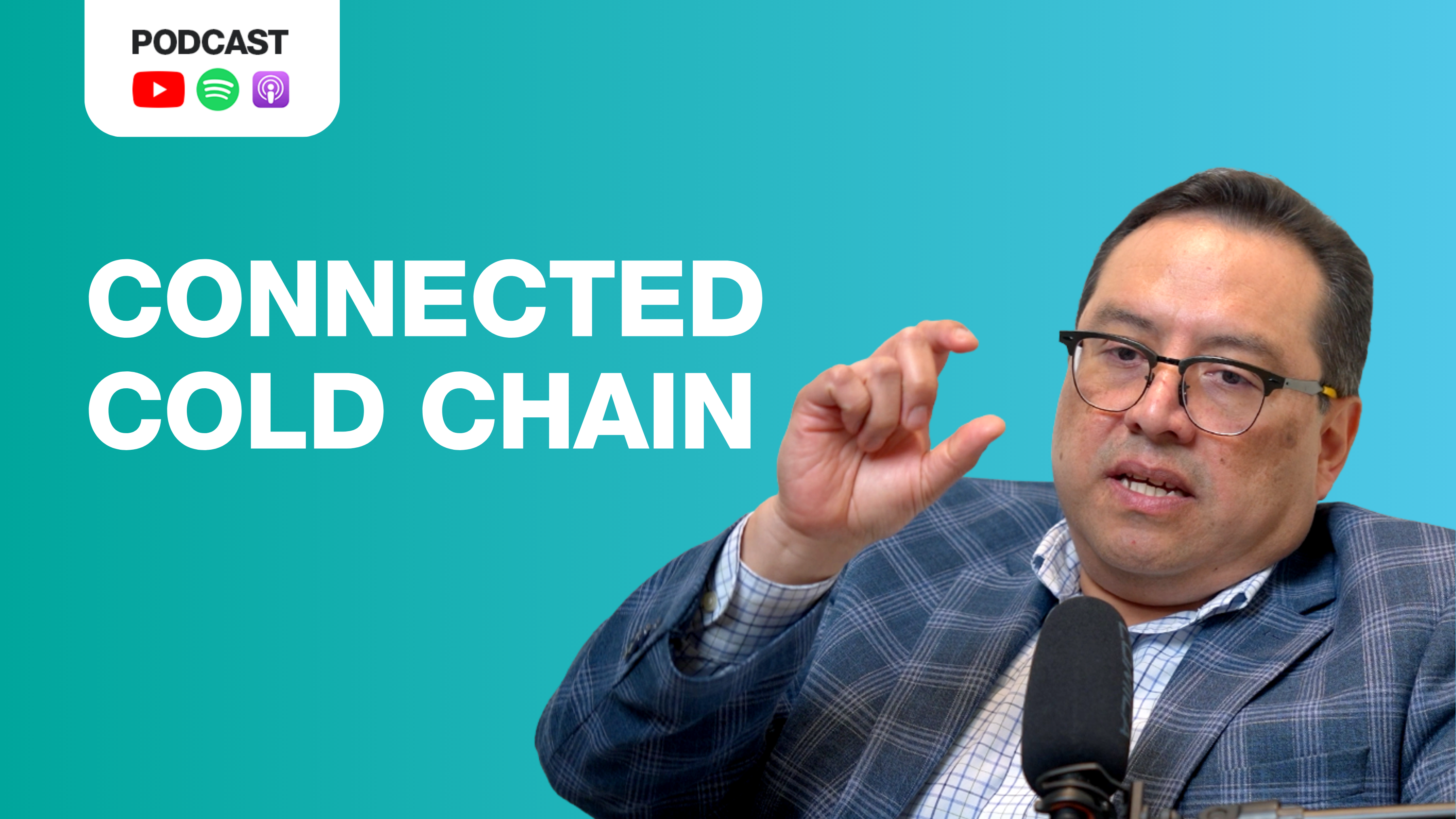
Connected Cold Chain podcast
Why pharma cold chain evolved this way. Are we stuck?
Pharma built rigid infrastructure and processes because patient safety called for control. Mauricio Reyna Flores speaks to Leigh Mays about why they need to adapt.
Focus area
Orchestration Across Partners: Who Really Owns the Shipment? | David Komjati
Supply chains are fully exposed
Connected Cold Chain podcast
Pharma built rigid infrastructure and processes because patient safety called for control. Mauricio Reyna Flores speaks to Leigh Mays about why they need to adapt.
00:46
Leigh Mays: Hi, I'm Leigh. Welcome to the Connected Cold Chain podcast. Today we're talking to Mauricio, and we're going to touch base on how infrastructure is either limiting or helping safety within the supply chain. Mauricio, would you like to introduce yourself?
01:05
Mauricio Reyna Flores: Sure. Thank you for having me, Leigh. Good to see you here in Puerto Rico. My name is Mauricio Reyna. I'm the lead of global transportation at BMS. I have the privilege to lead a talented team that oversees transportation operations in what we call primary distribution shipments, from internal and external manufacturing sites to distribution centers, and also inbound shipments. My team is also responsible for managing risk in the network, from crises like weather impacts and geopolitical issues, in order to mitigate the risk of disruption. This April, I've been at BMS 24 years, and I'm very happy to be here.
01:57
Leigh Mays: Wow, 24 years at BMS. That's a feat that's not happening much these days. I want to jump right in and ask about infrastructure within the cold chain, the corridors, the challenges we're having with infrastructure, and what's working. I always think of infrastructure as the background and backbone for what we're trying to do. I want to touch on how it might give us a false sense of safety, because we have all these stopping points built in to protect your products, and also on how it supports your products. There are some challenges with it, and we can talk about those.
02:55
Mauricio Reyna Flores: Definitely. Infrastructure is a good theme. We built this infrastructure accepting that something could eventually go wrong. We constructed everything because we accepted the risk of shipping time- and temperature-controlled products. But the process is part of the infrastructure too. Even if you have the infrastructure, that doesn't mean you're safe if you don't have the processes, or a team or group of partners doing something with that infrastructure. Something I didn't mention in my introduction: I have a law enforcement and security background as well. I learned how important infrastructure and processes are in one of my first investigations at BMS. I saw the cameras around and thought, okay, this investigation is going to be fine. The infrastructure was there. However, the camera I needed was not working at the time. I realized there was no process to check the cameras frequently. That's what I'm talking about. If you don't have the process for how you use the infrastructure, you're not safe even with the best infrastructure. So I'm a believer in processes, and also in identifying your focus, your objective, when using that infrastructure.
03:55
Leigh Mays: That's a really interesting point. The infrastructure is built to give you that sense of safety, but it can be challenging without what you describe as the process that protects it and makes sure everything goes through step by step. Does the infrastructure sometimes limit what you're trying to do, or do you create so many processes to protect yourself that it limits your agility? For example, in a black swan event, because we've had more of those geopolitical events lately. How would that affect you when you have such strong processes in place?
04:35
Mauricio Reyna Flores: As part of the patient safety strategy in our industry, it was natural to construct rigid infrastructure to keep everything under control. You expect something to go wrong, and you don't know how bad it will be, so you prepare for the worst-case scenario. However, supply chain has been evolving over the last ten years because of technology. The way we ship things today is not the way we shipped 15 or 20 years ago. Another thing we learned the hard way, through all these crises, is that rigid process limited our flexibility to react and to be resilient. It's important to me to involve every group that works with you, even if they are not logistics or part of the supply chain. The regulatory groups and the quality groups may not have exposure to how logistics works. In my experience, it has been very useful to bring them to the table and say: I understand the infrastructure and the need for it, but how could we do this in a different way without compromising quality? Help me find more flexible solutions. At least in my experience, that worked perfectly. My team is now really successful because we built, or adapted, this infrastructure to the new requirements of the new age of the supply chain, and we found a way to do it right. It wasn't easy. I answered this in five minutes, but it was very hard work. But it worked.
06:53
Leigh Mays: Creating processes is not an easy task. You create them and then you have to pivot or change them. I love how you started talking about technology, because it has changed drastically in the last five to ten years in giving you more flexibility and agility within your shipments. You can track things in real time and have more visibility as your product moves through the supply chain, and see where the challenges actually are. Are you experiencing that? Maybe you don't need to make two stops now where in the past you needed to make sure the container was charged, or the packaging was still in good shape, or the product needed to go back into cold storage. Has technology given you more flexibility to drive out some of the redundancy in your infrastructure?
07:50
Mauricio Reyna Flores: Technology obviously helps a lot to outline your strategies and see what you could use. But we need to be careful, because sometimes technologies seem like a fashion, like the latest trend. For us in logistics, I think we should analyze what the technology does, how it could be adapted to my needs, and how we are going to use it. I remember, in my old security days, when digital cameras came in to replace analog cameras. The conversation at that time was not necessarily whether we needed to convert from analog to digital, but how much image quality we needed. The best camera could give you a very nice image, but did we really need that quality, or could I live with a quarter of it? The costs were completely different from the sensors and devices we have now. I think it's the same today. We should be very analytical about what the technology provides and how we are going to take advantage of it. Just because it's fancy and modern doesn't mean it will fit my needs. It does help, but I still think real-time visibility is not at the level we would like. When we have it at the right level, you get more visibility into your supply chain and you can identify where the risk is and whether you need to do something. Right now it's not a standard process yet. There are a lot of regulatory aspects around devices and planes. To me, that is the next step: we have this real-time visibility, and we learn from the data where things are happening and perhaps why. But I don't feel it is 100 percent the responsibility of the service provider. As a customer, we have our own responsibility to review capabilities, challenge the solution, identify our own strengths and weaknesses in the process, and then construct a balanced, or even tailored, solution between the tool and the process.
11:27
Leigh Mays: How I see it is that all this real-time visibility gives you better data to make better decisions, and you can do it more efficiently. You have more information at your fingertips to identify areas of risk and areas where things are going great. Then you can look to change your infrastructure needs, or packaging needs, or whatever your challenges are. Maybe drive out some cost using this data. I think it's interesting how we're capturing it and how you're interpreting it, because each pharma company has its own nuances in its products and the requirements it has to move them within. I'm also fascinated by how you stay on top of so much data coming in. Is that a challenge?
12:32
Mauricio Reyna Flores: Let's talk about the challenge of too much data. First of all, the challenge is what we are going to do with the data, and whether it is the correct data to make our decisions. To me, that is part of the analysis we need to do at the beginning of adopting this technology in risk management and weather, for example. I mentioned that is a responsibility of my team. I need someone looking into the data and the weather event, and another group checking whether I have in-transit shipments through that area, or bookings in the future. If I don't have that process around the data, I could have the best weather alert tool, but if nobody is looking at it and nobody takes advantage of that data, you don't get the benefit. For temperature control, how frequently do we need the records? Are our temperature ranges correct, or are they inflexible? Am I interested in the outside temperature or not? Vibration, light? Everything is available, but what do I really need to protect my product? Once you answer that question, I think the next steps are natural. When you have identified your focus and the benefit, then you can construct the process. The challenge, of course, is that we are a highly regulated business, even for data. Another challenge is helping the regulatory and quality groups understand the data, how we are going to use it, and its integrity. If the data is going to be used for product release, that is part of the challenges we face in the pharmaceutical business.
15:13
Leigh Mays: I think about how much data you have to manage, and the uniqueness of each product you ship. We did some recent studies and polls within the industry, and people said they're having more challenges with excursions. It's fascinating to me to wrap all this technology in and still understand why excursions are happening, and what we could do to mitigate them or help you prevent them. Do you have any thoughts on that?
15:54
Mauricio Reyna Flores: It has been interesting for me to work with our temperature control team and, at the same time, on logistics incident reporting. I remember a conversation where I asked: if this temperature deviation is not impacting the product, should we continue calling it an excursion? Because when you hear “temperature excursion,” you immediately think there is a problem, and then we need to do a lot of things. To me, everything is about mitigating the risk. I should be honest with you: I would never outline a strategy with zero risk. There's no such thing as perfection. In logistics, a lot of things may happen outside of your control.
16:57
Leigh Mays: Right. In manufacturing you have control from the starting point to the finish line.
17:02
Mauricio Reyna Flores: That's right. In transportation, there are a lot of moving pieces and a lot of partners, so it could be almost impossible. However, if you analyze what is happening in a particular lane through data, you understand where your risk is. Then, if that risk is acceptable, you focus on what to do to mitigate it as much as you can. If it is out of control, it's going to create an issue. I really like trending. I like to see what the data is saying. Sometimes you need people trained to see data, who help you say: I don't know if this is good or bad, but you need to take a look. The concept of temperature curves has evolved as well. It's not the same concept. We need to understand and accept the risk, and then we can be more effective in managing these moving pieces and uncontrollable situations.
18:28
Leigh Mays: This has actually helped me quite a bit. I'm fairly new to pharma logistics. I've worked in the construction industry in the past, and hearing how you've developed processes reliant on infrastructure, with all this control built in to deliver your product, is useful. But there are so many variables, like weather, black swan events, and geopolitical events. We could go on about the things outside of your control. I feel you've done a very good job of getting pharma to the most critical patients all over the globe. Are there areas that are more of a challenge than others, or that need more processes? Or do you treat the shipments all the same and use consistent processes throughout the world?
19:28
Mauricio Reyna Flores: Nowadays we must be flexible. We must be creative in the solutions. Passive solutions for temperature control requirements like +15°C to +25°C are still a challenge for us. We need to continue analyzing what we can do better. Sustainability is another thing that is not new, but is more visible now. So to me, every lane and every product we ship is a different challenge. +2°C to +8°C is a little easier, in terms of the solutions you can identify in the market. But +15°C to +25°C is still a challenge. Sometimes tarmac time and the airports, the seasonal traffic in Asia and the Americas, are really challenging to control. These products are less sensitive to temporary temperature excursions, but if you don't do something, you're going to start having issues. We are in a very complex supply chain. You are talking about almost every region and every country, different operations at the airports, different cargo handlers, even different cultures in how to manage pharma. So the challenge is still there. We have better solutions, we have better technology, but we cannot drop the ball and say, hey, now we are good. I don't think that is happening.
21:44
Leigh Mays: As you describe it, I hear the focus on process and data, how you interpret it, and when you need to step in where the challenges exist. It sounds like you have a really good handle on where you are today. How do you see yourselves evolving into the future?
22:03
Mauricio Reyna Flores: Two aspects. First, real-time visibility and control tower strategies, to have full visibility into what is happening in the network. Then we are going to adopt AI capabilities to facilitate trending, reporting, and risk management. When we connect the dots from supply and demand planning through logistics, that is where we want to be: a centralized hub of information where decisions can be made easier and faster. We want to create a supply chain that is flexible, reliable, cost-effective, and sustainable. Our job in the following months will be to connect every piece of information to this control tower concept. From there, I think we'll be in better shape.
23:12
Leigh Mays: That's a great topic, and I love hearing it, because one thing we've been talking about is cold chain agility and how we can provide more flexibility for the challenges you're seeing. It sounds like you're connecting all of your data and making sure you have full visibility from one centralized location to make better decisions. Is there anything you feel the industry is lagging on that we should focus on more? The control tower data and the technology are here, but what's missing?
24:02
Mauricio Reyna Flores: I think collaboration and partnership should be seen in a different way. You are connecting your data with us, so the level of partnership should be different. We should be stronger than in previous models. You help us with the concept, but you are still helping us collect that data. It's important for our partners to understand why we are doing what we are doing. That's what I do every time I have the opportunity: tell them why we are doing this, why the control tower is important, why their data is important. I'd also like partners to continue providing us with alternatives for analyzing the data. What I've seen in the past is, okay, I have this product, I can give it to you and you do whatever you want with that data. In concept that's fine, but sometimes I don't have the time to do it. If you give us a full solution, where you provide the data but also do your own analysis and perhaps share trigger alerts, like, “I don't know if you already know this, but this is what the data is telling,” I think that will help us even more. If this is not only giving us the technology but also a little bit of the process, then we can work in a different way, as partners.
25:58
Leigh Mays: So what I heard is that you're looking for strategic partners who will help you solve your challenges in a data-driven way. We talk about some challenges, we address the areas you want to focus on, and then we understand the problems you're experiencing and come back with innovative solutions that drive out inefficiencies, drive down cost, and don't impact the deliverables of your product.
26:41
Mauricio Reyna Flores: That's perfectly said. You should also continue being open to the different solutions I will need to connect to my control tower. Perhaps your solution will not be 100 percent of the solution for me, and we will need to work as an ecosystem in this control tower visibility. Every partner will have a piece of the business. I think that is the evolution in the end.
27:18
Leigh Mays: That's important because this is a very complex supply chain with so many partners, each delivering its own piece. How do we all feather together to bring you one effective solution? It's been interesting being in logistics so far, because I see a lot of collaboration and support, company to company, to make sure pharma gets what it needs to deliver products safely. It's been fun so far.
28:01
Mauricio Reyna Flores: Logistics is a completely different world. What I really like is that every day is different. The solution you identify today for a specific problem will most likely not be the solution for the next one, so you constantly need to think and find another solution. It's very dynamic. You can have a good week in terms of stress, and then the next week something happens and the stress goes up. But it's dynamic and it's fun. You also need a motive for doing this. Of course, you get paid for it, but there should be something else. When I'm doing my job, I'm thinking of the person receiving that medicine. That is my motivation: what I'm doing is for someone in some part of the world waiting for that medicine. That's my fuel to be creative and find solutions without compromising security, quality, and everything else, because I know there is a person at the end of the process, a human whose life will be better because of all the effort and the challenges we go through.
29:44
Leigh Mays: As you're talking, I hear that we're always looking for consistency and reliability, and ways we can replicate these logistics. However, you have to have agility. You have to be nimble, because there are things so beyond the control of the logistics chain. You can't just say, today we're not shipping because there's a hurricane, or we lost power. You have to get creative and ask how you would do this differently today to make sure that patient gets their medicine.
30:27
Mauricio Reyna Flores: It has been an interesting journey over the last two or three years. In Covid we learned a lot, but then something different happened and we needed to find this flexibility, as you mentioned. We worked in advance with the groups that are key for this flexibility and creativity. Once we caught their attention and explained why this was important, we started to collaborate in a way that they were suggesting things for us as well. I used to tell the quality team, for example: “Guys, I'm not here to hear a no. I'm here to learn from you how we are going to do it.” We need to transform from the no to the how. It wasn't easy, but this is the way we found flexibility, by talking and collaborating with every group across logistics, not only transportation: warehousing, quality, regulatory. I remember a time when we were able to have a person from the regulatory group assigned to our team. That person was our liaison with the different regulatory groups, which is another challenge for logistics. You go to regulatory expecting to speak with one person, and you find a very complex structure in regulatory, or even in quality. So we talked to the leaders of that organization, and one person was assigned to us. That person helped a lot, asking questions like, why are you doing this, why do you need this and that, and bringing that message to the regulatory group. After they understood and identified a way to help, it was a blessing for logistics, because everything went smoothly. There are some countries that are stricter than others, and we need to continue keeping what we are doing. But I can tell you [inaudible] was like 90 percent after this exercise. It took almost two years to do it. Now it's not that we were lucky. It's because the process is working. We are being successful in moving freight through these difficult times because we built these processes, we worked together, and we anticipated as much as we could. Now we are seeing some benefits of the process.
33:47
Leigh Mays: That's fantastic. As always, every time I talk to you I learn something new, and I so enjoy these conversations. Any parting words you want to leave us with as we wrap up Connected Cold Chain?
34:06
Mauricio Reyna Flores: Real-time visibility, training, technology plus processes, to learn in advance what is happening. The control tower, AI capabilities, everything that is coming. I think that is the future of this strategy for cold chain. I'm enjoying this. It's a very passionate topic, cold chain and logistics. Thank you for having me. It has been a pleasure and a lot of fun.
34:50
Leigh Mays: In my parting words, what we're talking about is the evolution of cold chain toward more flexibility, more agility, and more data-driven decisions. Not necessarily a revolution, because we can't change overnight with all the challenges and complexity in the logistics space. But the evolution is happening.
35:09
Mauricio Reyna Flores: Definitely, it's coming, and we need to be prepared. We are in the middle of a lot of controversies about AI, and things that maybe will not happen. But be prepared. If we need to learn something new, let's learn how it works and whether it is for me. Partnerships, I should be honest with you, are the foundation of everything. If you don't build good relationships with your partners, everything is going to be more difficult. Being honest, transparent, and having the room to challenge one another is going to be fundamental to support this evolution you are mentioning.
36:10
Leigh Mays: My personal motto is always: be part of the solution, not part of the problem.
36:14
Mauricio Reyna Flores: Correct.
36:15
Leigh Mays: That's a very good one. Pleasure talking to you today. Thank you so much for your time.
36:21
Mauricio Reyna Flores: Thank you.


In Episode 2 of the Connected Cold Chain Podcast, Leigh Mays speaks with Mauricio Reyna, Director of Global Transportation at Bristol Myers Squibb (BMS), about the future of pharmaceutical supply chains and the evolving role of technology, data, and collaboration.
With over two decades of experience in global transportation and healthcare logistics, Mauricio shares insights on building resilient, patient-centric cold chains through stronger partnerships, real-time visibility, data-driven decision-making, and cross-functional collaboration.
In this episode, you'll learn:
Why technology alone isn't enough to ensure supply chain success
How visibility and control towers improve cold chain performance
The role of AI and data analytics in risk management
Why collaboration across quality, regulatory, logistics, and technology teams matters
How pharmaceutical supply chains are becoming more agile and resilient
Watch the full conversation to discover how leading pharmaceutical companies are preparing for the next era of cold chain and supply chain management.
Connected Cold Chain brings together the people who shape, run, and improve pharmaceutical supply chains. Each episode features open conversations about how the industry is evolving and what it takes to build a more connected cold chain.
A new episode publishes every month.
Three questions from the conversation, answered from what Mauricio Reyna Flores said.
Infrastructure protects product only when a process uses it. Mauricio Reyna Flores points to a security camera that failed when he needed it, because nobody had a process to check the cameras. He says cold chain infrastructure needs the same: defined processes, a clear objective, and a team or partners who act on it.
Reyna Flores says to involve quality, regulatory, and other groups early and ask how to reach the same goal differently. At BMS, regulatory leaders assigned one person as liaison to the logistics team, which he says made the work run smoothly. He describes the full effort as taking almost two years.
Start with what the technology does and how it fits your needs, he says. Then answer what the product needs protecting from, such as temperature, vibration, light, or outside conditions, and build the process around that answer.