Transcript
01:07
Michael Haley: Welcome to the Connected Cold Chain podcast. My name is Michael Haley, and today we'll be discussing a very interesting topic with Jeff Tucker from Tucker Company: high-risk lanes and how leaders stay in control. It is my absolute privilege to introduce Jeff Tucker.
01:26
Jeff Tucker: Thanks, Michael. It's good to be here with you, and thanks for the invitation. I'm Jeff Tucker, CEO of Tucker Company Worldwide. We're a third-generation, family-owned freight brokerage, the oldest privately held one in the US, and we specialize in the movement of pharmaceuticals.
01:38
Michael Haley: Great. Thank you, Jeff. We'll get started. From your position within your organization, I think this is a very interesting topic to share, from a domestic standpoint: how you engage with your customers and move high-value products across the United States. I'm very keen to see how some of these answers go, so we'll jump right in. To set the stage, think about limited infrastructure at some origins and destinations, power supplies that may or may not be capable, a lack of backup equipment, underdeveloped facilities. The list can go on and on, and these challenges can disrupt the effective distribution of medication across the United States. You're a final-leg, origin or delivery, transport company, so I'm keen to see how you play into this, especially as biologics and more advanced therapies come into domestic use, and how you manage what we might call tricky lanes. The reality is that these high-risk lanes rarely fail because they're impossible. They fail because they're poorly designed. So, with that, to start: from your perspective, what turns a pharma transport lane from routine into tricky?
03:08
Jeff Tucker: A variety of factors can lead to that. I think it's important, Michael, if I can, to say that to provide road transportation service to this industry, you have to be serious. Over the last year, the industry has gotten quite serious about its commitments and its accreditations: Good Distribution Practice (GDP), and now Transported Asset Protection Association (TAPA), which is the highest level of security. To even play the game, to be in this important business of saving lives with your transportation, you have to subscribe to these requirements. You have to be audited and deemed accredited to both of these high levels. One is about the safety and efficacy of the product, protecting that. That's GDP. The other is the highest level of security, TAPA. If you think of it as a pyramid, that's your base, your starting point. It has everything to do with the motor carriers you use to support the business, the equipment, the technology they use, and the training they give their team. Their drivers need to be trained. The equipment has to be proper. The list goes on, and we're still just talking about the starting point, before we get to your question about the lanes. Once you have that foundation of excellence and thorough understanding, the question is whether communication across all the parties is effective. One of the biggest challenges we've found is sometimes getting exactly what we're supposed to get from the customer. It's not necessarily the customer who is the issue. Their transportation management system (TMS) or their third-party logistics (3PL) provider, the one distributing the loads to the service providers, may not be 100% in line. And in this business, efficacy is everything. Data is everything, and performance is everything. So it's a multifaceted answer to your question, but I felt I needed to start at that baseline. When you have that baseline understanding, you can flex. You're well trained, and your team knows where to go to escalate a situation and get an answer.
06:03
Michael Haley: You make a really good call-out there, Jeff. Long before the lanes become tricky, it's that collaboration piece: understanding the quality, the communication, and the design and setup needed to make sure the lanes aren't so tricky. So I'm curious, from Tucker's perspective, about the process control and due diligence you put in long before you engage on a lane. Can you give us some insight or an example of how you control these processes? What mechanisms are in place to make sure you're collaborating with your client and your partners, and that the full-circle quality aspect is robust enough that when you do engage a tricky lane, it's not so tricky anymore?
06:52
Jeff Tucker: It's a good question. I've been coming to the health and personal care logistics conference since 1992, and one of the big takeaways for me was that these manufacturers were tired of trying to fit into the big integrators' machines. They wanted a very customized approach to their business. We have a vice president on staff whose entire job is to operationalize the contractual and standard-of-care requirements of each customer, so that the customer gets exactly what they want in terms of service, data, and communications. We could have three customers where the average person would say, well, each one makes cancer drugs, each one makes vaccines, how would I even know the difference? We know the difference, and they know the difference. They know specifically what they want from their service providers. So our primary approach is to understand thoroughly. Sometimes that's a little frustrating for customers. When you ask questions about their contract, they get frustrated: why don't you just sign the contract? Everyone else signs it. Well, we're trying to understand exactly what you want, so that we can give you the flavor, the color, the size, and so on, that you're looking for. That's the start of it. Then we build the collaboration. What we've found over time is that when we tell a customer about observations that can save them money, save them time, or help their operation, it builds trust, and they look to us for more of that kind of help. That's a little of how we go at it. We have been doing this for 40 years in pharma, and you have a core group of carriers who have been with you for a number of years. You continue to collaborate. We have an individual whose responsibility is to do nothing other than coordinate and collaborate with our close carrier partners and provide additional training to the carriers that move this type of freight. There is a very small group of carriers in the entire country that are qualified. These are really close partners. They see eye to eye with us on what we need and what our customers need, and they're willing to go the extra mile.
09:52
Michael Haley: I want to stay on this topic, because you're diving into something quite unique from your perspective, and we also see an industry change in this knowledge base. How do we leverage knowledge in organizations to make difficult decisions, where a client may be driving you into a position or a corner that, from history, you and your organization should not be in? Whether it's, as you said, "just sign the contract," or "we just need this done," or X, Y, and Z. From Tucker's perspective, how do you leverage this knowledge to forgo red flags, or customers driving you in a direction that may not suit your quality program, knowing that you work at the highest level? How do you use this small group of people to position yourselves and your customers toward the right path, when the client may not believe it's the right path? It may be a difficult conversation or question to ask, but how do you use that knowledge internally to perform externally?
11:10
Jeff Tucker: I'd say there's no easy answer and no easy solution. You just have to be consistent in your communications. One of the things we try to do is build more connections within a customer. We don't want to have just one or two people at the customer. We want to build relationships up and down and left and right within the client, and we need to be able to have that open line of communication. If someone just wants us to sign the contract and really doesn't want to collaborate, that's not a good fit. This business, as you well know, is the highest stakes. Each one of us is out there doing our job, saving lives, moving critical medication. If there's a collaborator who doesn't want to collaborate, it's not a good place to be as a service provider. So we're looking to build strong relationships so that we can collaborate and come to solutions. One of the things we've been trying hard to implement over the last year or two is using data to tell a story, versus just sharing the data. There should never be a slide showing data in a quarterly business review. What's the point? We ask ourselves what the takeaway is. If we have a problem that requires two or three different angles to cover, we put that into a story that lands. Sometimes we get a good audience with the client and we say, this is the problem we see, and this is the solution. We try to come up with three solutions: one problem, three solutions, and this is our recommendation, one, two, or three. If the client eventually says no, it's impossible for us to do that, then we say, okay, but this is the risk. And if they say, okay, we understand that, then we have a mutual understanding that there may be a risk.
13:41
Michael Haley: Sure. Interesting. Relationships are always king, especially when you're having different conversations and asking difficult questions. When you have that power of relationships, it overcomes it. It's everything.
13:52
Jeff Tucker: It's such a funny thing, too. Every day we're more digital. We're employing AI. But in the end, you really have to trust your partners, and you have to trust the people behind that data and those systems. That's where it's at.
14:15
Michael Haley: You bring me to a very interesting topic here, Jeff. I love how you bring me into things. AI and data are such powerful tools in our industry nowadays, and I think people are just starting to understand how to use data. It's one thing to have big data pools, but what do you do with that data? How do you put it into action? That leads me to my next question. How do you use your 40 years of data and experience to put controls around the day-to-day, where chaos inevitably exists? Can you give us a little of the journey: what do you use to enable that data to manage the day-to-day, and maybe even to intervene or build case studies to present to your customers?
15:13
Jeff Tucker: Boy, that's a lot. How many hours do you have? A couple of things. I mentioned digitalization, and there are a lot of folks in my space. There are 350,000 trucking companies, 20,000 brokers, and who knows how many forwarders. Virtually no forwarder has their own trucks, so they're brokering road transportation 99% of the time. You start with that, and you talk about chaos. That is a mess of chaos. What do we do? Again, we're very different. We have a core group of carriers that thoroughly understand what we need. Some of the AI we're employing right now takes tracking data from a variety of sources. It could be the carrier, the carrier's software, or an intermediary's software. We put all of that into our system, and then we run AI agents on top of that data. Our people are laser-focused on the whereabouts of shipments, and now the data is also being evaluated continually: how many hours are left on that driver, how many hours are left on that truck, how many miles are left to go. That lets us intercept shipments far more effectively. Then there's the competition. Virtually every broker, carrier, and forwarder road operation uses load boards to move freight. It's super simple and super easy, but it's super risky, especially today with fraud. We prefer a more cautious approach than the winging-it of a lot of the marketplaces. We use a lot of digital tools within our relationships. However, there's a two- or three-minute conversation that we feel we must have with the drivers of the vehicles carrying our loads. It starts with an open-ended question: I just wanted to make sure, do you have all the details on the security requirements? Well, yes. Okay. What do you know? Well, what do you mean, okay? That's a good question. Then we ask, what have you been told? Because there might be a newer driver on this. If we feel in any way that the driver is not fully prepared, part of the question will sometimes be, hey, did you hear about that husband-and-wife team in Memphis last week? And you just let silence happen. Oh, no. What happened? Well, they left their dog in the vehicle. They thought that would be okay. They went inside. One of them was supposed to stay with the tractor. They came out and the tractor and trailer were gone. So it was their dog. [unclear] That gets the hairs on the back of their neck standing up, and now you have their attention. One of the biggest challenges in today's world of high-value cargo is that a modern tractor has a big computer screen in it. These drivers are rifling through it, just like we do when downloading an app on our phone: yes, yes, yes, yes. They just want to get to the address. It's our job, and in 64 years of doing business, 40 years of it in pharma, we have never lost a shipment, to get them out of the blind mindset and into the moment. That's been tremendously successful.
19:33
Michael Haley: Amazing. I want to stay on this risk topic. I think all of our viewers would hate to lose their dog and the truck. You might find insurance covers the truck, but never take my dog away from me. It's a whole John Wick thing.
19:46
Jeff Tucker: Yeah. Indeed.
19:48
Michael Haley: Staying on the topic of risk: at Tucker, what elements do you take from a risk mitigation perspective in lane design? During that design, what are the non-negotiables, the things that are absolutely not on the board when it comes to designing a lane with your truckers, or internally with your clients? From a risk perspective, what roads are you just not willing to go down when it comes to protecting [unclear] and not losing anything?
20:28
Jeff Tucker: What is not negotiable is the efficacy of the product: a temperature excursion, or loss of any kind. Unattended vehicles. Data integrity around all of this. Those are all non-negotiables. What we do like to negotiate, especially as times get tight, is pickup time and destination time. For example, if we're asked to pick up something a day earlier than the transit requires, that would mean sitting with that tractor-trailer somewhere. It could be a secure yard, and that's great, but wouldn't it be far better if the shipment could sit in the warehouse and we pick it up a day later and still make the transit time? So we like to negotiate things that make good, practical sense. The timing of the transportation is important. Some of the other things we look at, Michael, are short-haul lanes. A lot of our clients ask for team service, but some of the lanes are only 150 to 200 miles, and under almost any circumstance a single driver can handle that. So we ask the client: from a security perspective, we see nothing wrong with 150 miles, same day, with a single driver. What are your thoughts? We'll collaborate with the client there. Sometimes it's an absolute no. And sometimes they say, oh my gosh, we didn't even know that.
22:10
Michael Haley: Thank you. That makes a lot of sense.
22:13
Jeff Tucker: Secure yards. That's another one. In terms of risk mitigation, our team is always looking for secure yards. What's a secure yard? It's a place that is entirely fenced in. There are cameras. There are guards, 24/7. And it's not a roadside truck stop, because those aren't guarded. When you're in transit with a high-value load, there has to be a secure yard. Each client has a slightly different definition, but they're all very similar. So we're actively and regularly identifying and securing, within our network, the secure yards where we can park a truck and trailer and have the drivers stay with the vehicle.
23:04
Michael Haley: It makes me feel a lot safer receiving our medications when they're in Tucker's trucks.
23:13
Jeff Tucker: Right. Amen.
23:15
Michael Haley: So, the last question I want to wrap up with for our viewers is a bit of an open softball. From a risk perspective, Jeff, what keeps you up at night? What is the future bringing that makes your mind race when you lie in bed? There may be a hundred different answers, but from your perspective, what's the one single focal point you're looking at in the future?
23:50
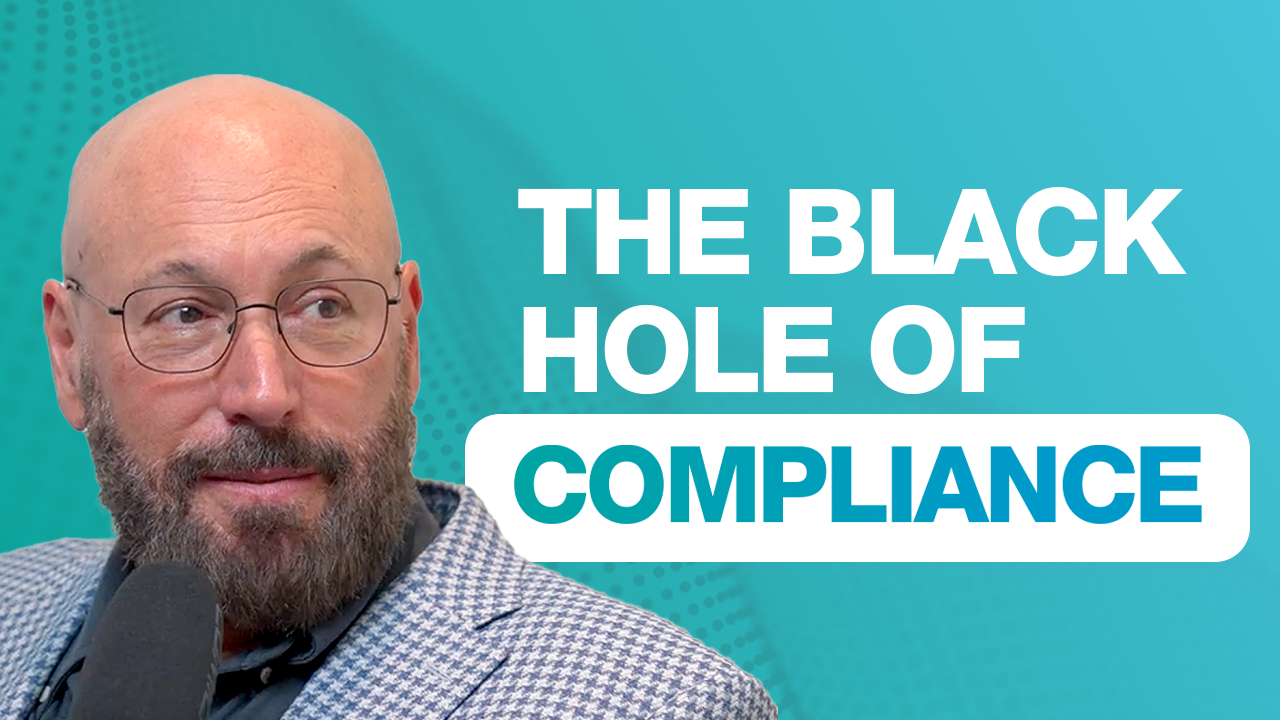
Jeff Tucker: I speak a lot about what I refer to as the black hole of compliance. I mentioned earlier that there are 350,000 trucking companies and 20,000 brokers, and a wide number of forwarders. Forwarders in North America largely do not own their own equipment, so all of their freight is brokered by definition. The black hole of compliance works like this. If you are a drug company, you go out and validate your suppliers. That is the norm. But nobody is validating the motor carriers that are being used by any of these parties. If you are GDP accredited, if you are TAPA Tier 1, you are held to that level of expectation and audited against it. What is true right now is that there is no global forwarder whose road operations in North America are GDP accredited. Their facilities are, clearly, no problem. But as of this date, their road operations are not. So what is happening with that freight? And are the manufacturers holding their forwarders to the expectations they would hold their primary service provider to? Are the forwarders holding the brokers, and the brokers the carriers they hire, to those expectations? It's more of a rhetorical question, and I already know the answer: nine times out of ten, no. It's a challenge for us when we go in with full expectation of providing that level of GDP-accredited service, because I don't think we're being judged against that on pricing. I don't think there has been enough focus by the manufacturers on this whole subculture, so to speak, of what's happening beneath the surface. Until there's a light shone on that, there's a lot of medication at risk in North America. That's my specialty. I can't speak to the rest of the world, but if that's the case in North America, I can only imagine what's happening elsewhere. And we'll hear, oh, well, my contract with my forwarder, or with my air carrier, says this. Yes, but the TAPA committee that created its top tier, Tier 1, for road transportation included a major global insurer. That is a pinball that's going to be reverberating through the industry over the next few months. I think there's going to be a lot more focus on it from the chief financial officers (CFOs) of pharma companies, because they're the ones buying the excess insurance. I and others who hold ourselves accountable have been waiting for a point where we can be judged on a level playing field, where all of us provide that level of care and security. I think what will probably push it over the edge is the insurance industry saying, hey, pharma, what do you tell me about what you're doing with truck risk? Not just with your primary providers, but with your forwarders, your air cargo carriers, and so on. The chain of custody is so critical.
27:52
Michael Haley: That's something we could probably talk about for the next few hours, but unfortunately we're out of time for our podcast today. Jeff, I thank you for your time, and I really appreciate your input. I hope everybody out there did as well. Thank you so much.
28:07
Jeff Tucker: Yeah. Appreciate it. Thank you.
28:10
Jeff Tucker, added after recording: Shortly after we recorded, the Supreme Court ruled in a major case involving freight transportation. A broker hired a motor carrier, the motor carrier was involved in an accident, and the broker was sued under state negligent-hiring law. The case was Montgomery v. Caribe Transport II, and the long and short of it is this. A defense that works some of the time, in some states, is federal preemption: federal law should preempt state law when it comes to interstate commerce. The Supreme Court disagreed and said the states can handle these cases, so the case can proceed in the lower courts. What concerned me, and what rattled a lot of people's cages, was that social media and some of the media following trucking got on a soapbox saying this is a new rule, this completely rewrites freight transportation. As someone who co-wrote the first trade-association-endorsed guidelines for carrier selection in 2005, on the heels of the Schramm v. Foster case in 2004, I can tell you that no, this isn't new. It has been around for 22 years, and we have been managing to this risk for 22 years. Another false assumption is that this is a broker case. Yes, it involved a broker, but it's also a shipper case and a global freight forwarder case, because each of those three entities hires motor carriage directly. If you hire a motor carrier directly, I don't care what your company is, you're on the hook for this liability. Essentially it means you should have a written policy, and you must adhere to it at all times, not just when it's convenient. In this case, C.H. Robinson used a conditional motor carrier, which carried an especially high risk relative to other types of carriers with different ratings or no ratings at all. I would strongly recommend, if you are a pharmaceutical manufacturer, that you build GDP accreditation into your requirements for forwarders, for brokers, and for yourself when you hire a motor carrier. TAPA is the highest level of freight security, and I strongly suggest you incorporate that accreditation into your standard as well. By doing this, you'll be protecting yourself, and you'll be in a far better position to defend your decisions in the future. Thank you, SkyCell, for allowing me this extra time. I'm happy to talk to anyone who wishes to talk about this issue.