PIC/S PI 006-4: what changes for pharma manufacturers
Transport verification now has its own section in the guidance GMP inspectors are trained on. Here's what it asks of your QA, supply chain, and logistics teams, and how to get your lanes ready.

Transport verification now has its own section in the guidance GMP inspectors are trained on. Here's what it asks of your QA, supply chain, and logistics teams, and how to get your lanes ready.
PIC/S brings together 57 medicines inspectorates, including the US FDA, EU national authorities, the MHRA, Swissmedic and Health Canada. Its guidance is what their GMP inspectors are trained on.
For the first time, that guidance covers transport in detail. You can put it to work straight away: write it into your supplier qualification and quality agreements, and your forwarders, carriers and handlers are held to it from day one.
You already assess transport risk. PI 006-4 raises the standard of proof, and the workload grows with every lane you run.
Write the test protocol first
Your team writes and runs a test protocol, and approves the report before the first commercial shipment.
Bring every lane into scope
Domestic legs, site-to-site transfers, API, bulk, semi-finished product, and samples need the same assessment as your export lanes.
Keep lane risk assessments current
An annual review is no longer enough on its own. Revisit the assessment as your network changes, so new risks are captured as they emerge.
Treat logger data like batch records
Place loggers where the risk assessment calls for them. Each logger needs a clear link to the data it produced, plus a record of calibration and download.
Most registers were built around finished-goods export lanes. Four questions to ask your team:
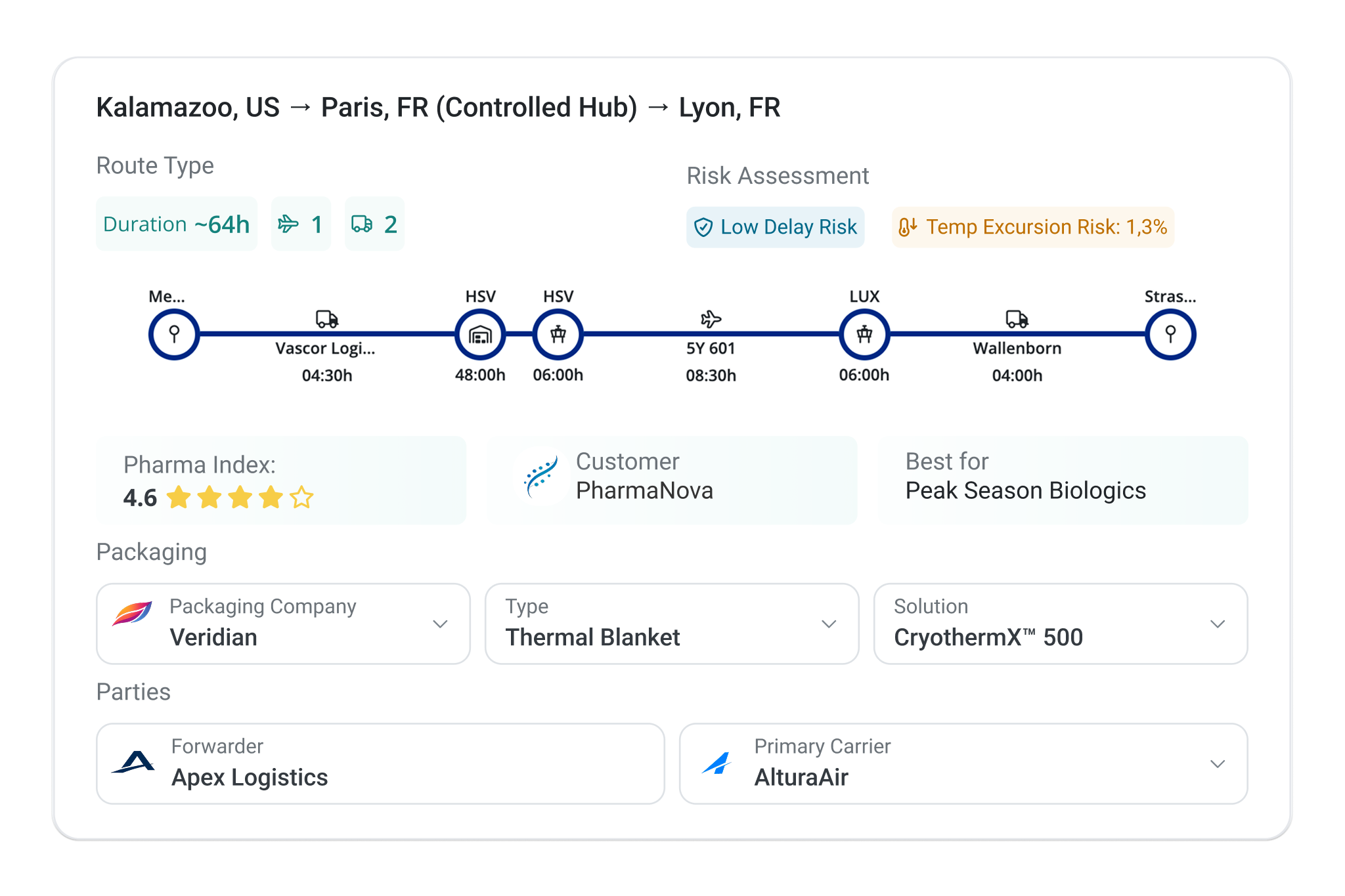
PI 006-4 is a recommendation. Annex 15 sits in the GMP Guide that regulators adopt into their own rules, and both the EU and PIC/S carry it. That is where transport expectations become enforceable.
Annex 15 is being revised now, transport included, with a revised text expected to follow PIC/S guidance. Verify your lanes to PI 006-4 today and they already meet where Annex 15 is heading.
Hold API, bulk, sample and domestic lanes
in one register
Update lane risk assessments when routes or partners change
Simulate packaging performance on a lane before you ship, to support your verification study
Qualify forwarders, carriers and handlers with current capability profiles
Keep controlled records with a full audit trail
PIC/S and the EU keep their GMP guidance closely aligned. Annex 15 has covered transport since 2015, in four short paragraphs. PI 006-4 adds nine, with far more detail on routes, test protocols, data loggers and samples.
It shows where the bar is heading. The European Commission consulted on a concept paper for revising Annex 15 between February and April 2026, and a revised text is expected by the end of 2026, adding more transport guidance and extending it to active substance manufacturers. PIC/S adoption is expected on the same timeline. Lanes you verify to PI 006-4 today put you in a stronger position when the revised Annex 15 arrives.
It's guidance. It becomes binding when your national regulator adopts it. Until then, it shapes what GMP inspectors look for, and you can write it into your own supplier qualification today.
No, verification needs a test protocol and a trial shipment. A lane risk assessment is where it starts: it shapes the study and the controls you choose for each lane.
At a frequency you can justify on risk. You set the policy, and you defend it in an audit.
Logger use is a risk-based decision. Your lane risk assessment decides whether a lane needs loggers, and where they go.

Customer story
“As we enter new markets, we now have a simple, reliable way to assess risk.”
Read case study