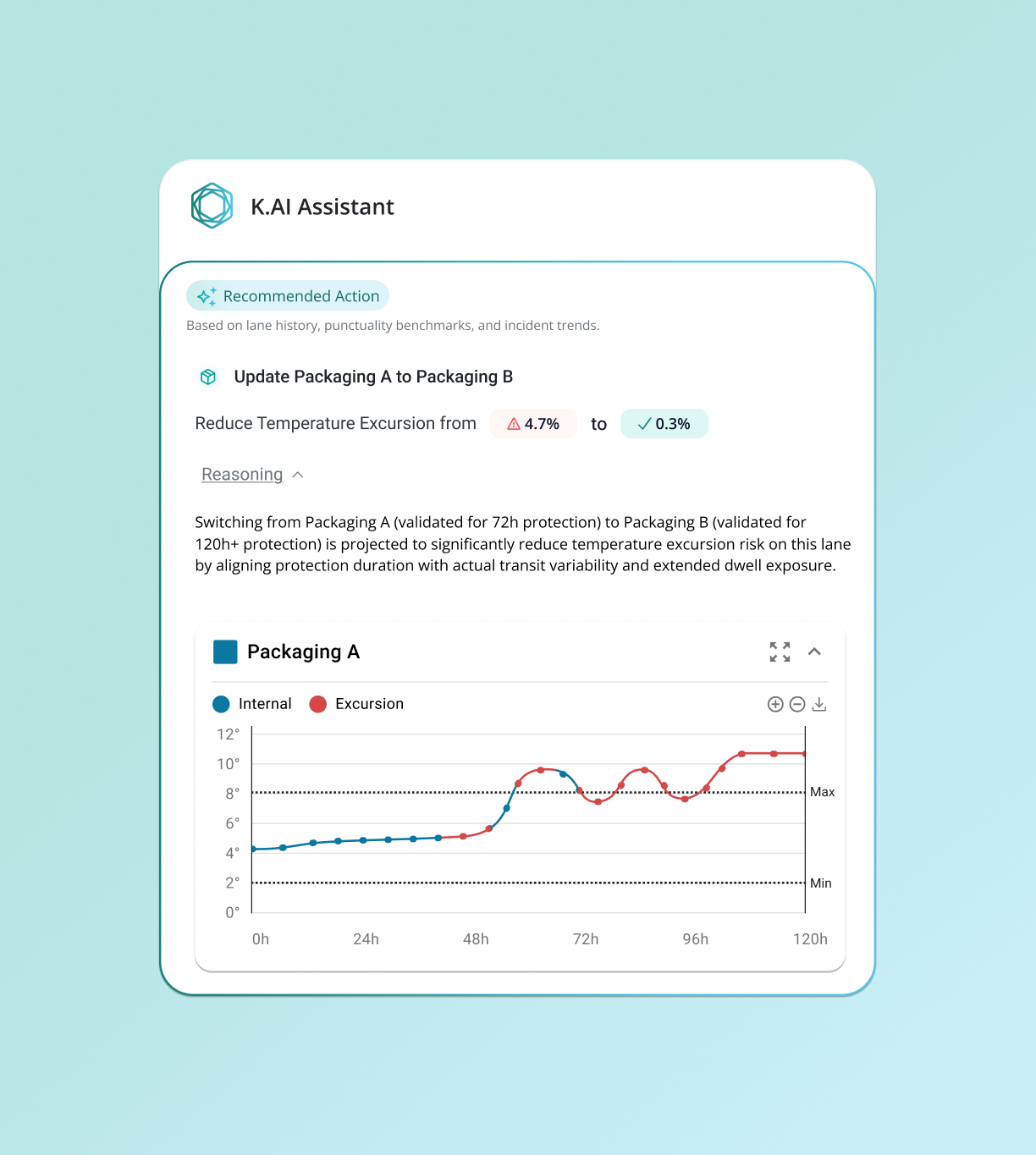
Why one lane's result doesn't transfer
Packaging performance is a function of the challenge it meets, and the challenge changes lane by lane. Duration, ambient temperature, the number and length of dwell times, the season, and the handling profile all vary, sometimes enormously, between two routes carrying the same product in the same box. A passive system with a 96-hour coolant profile is comfortable on a 60-hour lane and dangerously thin on a 90-hour one that hits an unplanned customs hold.
This is why a qualification result is bound to its conditions. It certifies that a system held a range over a specific duration and ambient profile. Move the system to a lane with a longer duration or a hotter profile, and the certificate no longer covers the shipment. Across a portfolio of dozens or hundreds of lanes, the question is not "does this packaging work," but "on which lanes does this packaging work, and where does it run out of margin."
What portfolio-level assessment actually asks
Assessing packaging across a portfolio means answering a set of questions that single-lane qualification never has to.
-
Coverage: Which lanes does each qualified packaging system actually cover, given each lane's real duration and ambient conditions?
-
Margin: On the lanes it covers, how much headroom is left before the system is at its limit? A system that passes with two hours to spare is a future excursion waiting for one bad delay.
-
Gaps: Which lanes have no properly qualified packaging option, and are shipping on an assumption?
-
Consistency: Is performance being judged the same way across every lane, or is each route assessed by whoever set it up, on whatever evidence they had?
-
Change: When a lane's conditions shift or a new lane is added, does the packaging assessment update, or does it stay frozen at the last review?
A portfolio assessment that answers these turns a drawer full of individual certificates into a single view of where the product is genuinely protected and where it is exposed.
Why spreadsheets break at portfolio scale
The manual version of this assessment is a matrix: packaging systems down one axis, lanes across the other, performance data filling the cells. It works for a handful of lanes and collapses past that, for the same reasons manual lane risk assessment does. The data lives in separate places, each cell is filled by hand from a different source, and the whole matrix is accurate only on the day it's completed. A carrier changes a routing, a season turns, a new lane is added, and the matrix silently goes out of date while everyone keeps trusting it.
At portfolio scale, the failure is quiet. No single cell looks wrong. It's the aggregate that drifts, until a lane that everyone believed was covered turns out to have been shipping on last year's assumptions.
Building an assessment that holds
A portfolio assessment that stays true has three properties. It scores every lane's packaging performance against that lane's real conditions, using a consistent method, so results are comparable across the portfolio. It draws on maintained performance data, not one-off manual entries, so the assessment reflects current reality. And it updates as lanes and conditions change, so coverage and gaps stay accurate between formal reviews. Those three properties are what separate a living view of packaging coverage from a snapshot that started aging the moment it was saved.
How Validaide supports portfolio-level packaging assessment
Validaide is built to assess lanes at portfolio scale, and packaging performance is one of the factors it scores. The Dynamic Pharma Index weighs the protection a given packaging solution provides against each lane's temperature exposure and route duration and complexity, and it does so the same way for every lane, across a network of more than 70,000 assessed routes. Because the score is consistent and continuously updated, a team can see which lanes a packaging solution genuinely covers, where the margin is thin, and which routes need a different system, as one comparable view in place of a matrix of stale certificates. When a lane's conditions change, its packaging assessment moves with them, so coverage and gaps stay current as conditions change.
References