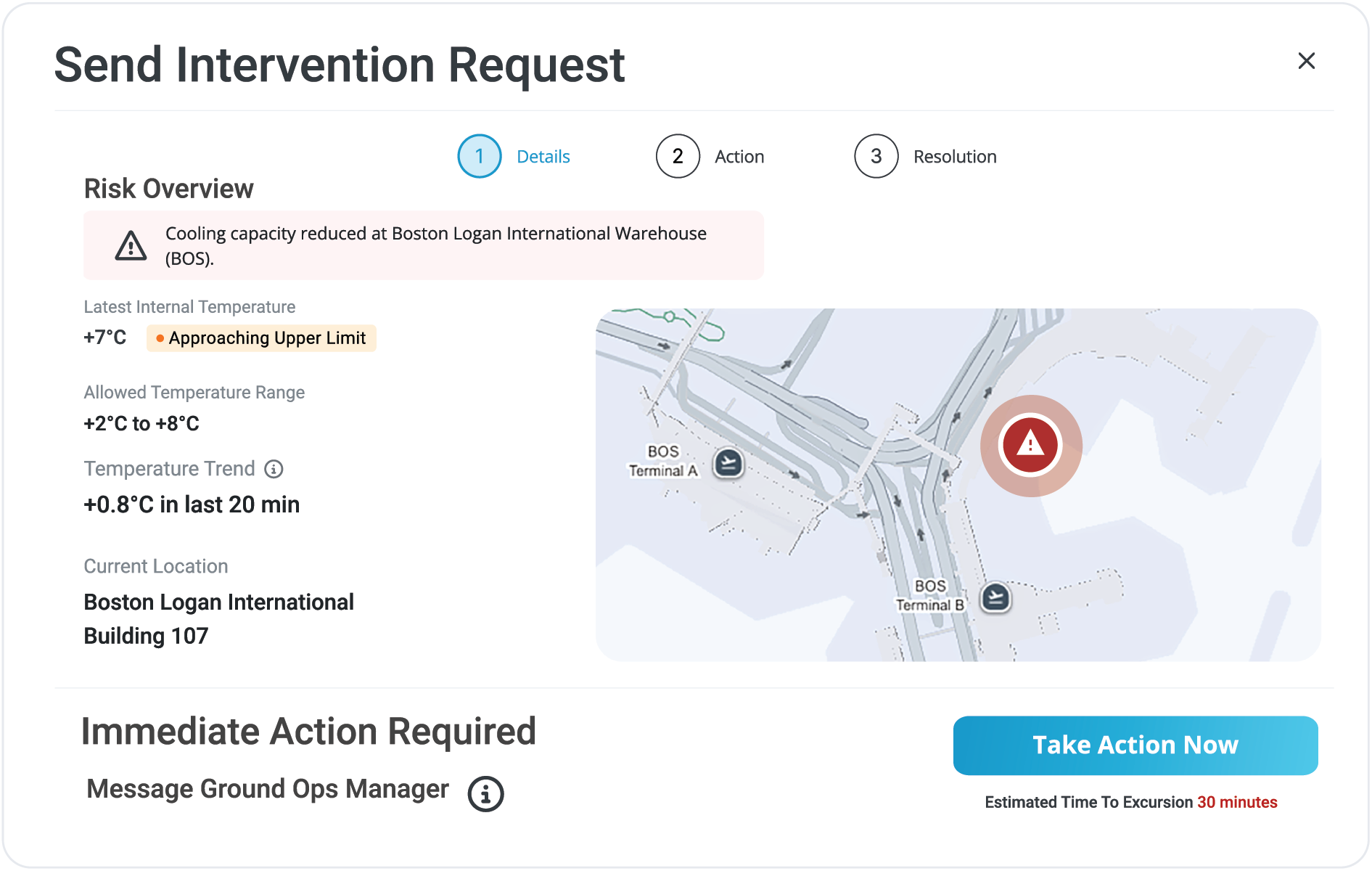
Reactive Management: Responding After the Fact
Reactive cold chain management treats risk as something to handle when it materializes. A shipment excursion triggers an alert, a team investigates, a disposition gets made, and a corrective action is logged. Done well, this is disciplined and necessary work, and every cold chain needs to do it. The limit is built into the timing: a reactive process starts moving only once something has already gone wrong.
The cost of that timing is measured in product. By the time an excursion fires an alert, the thermal budget is already being spent, and the best available outcome is damage control. Reactive management can tell a team what happened and stop it from happening the same way twice. What it cannot do is prevent the event in front of it, because it only engages after that event has begun.
Predictive Management: Seeing the Failure Coming
Predictive cold chain management uses data to estimate where and when a lane is likely to fail, and acts before it does. It reads the signals that run ahead of an excursion, a lane's history of delays, seasonal ambient patterns, a carrier's performance drift, dwell times creeping up at a transfer point, and turns them into a forward-looking risk score. When that score crosses a threshold, the team acts: reroute, requalify, change the packaging, or tighten monitoring, while there is still a decision to make, before it becomes a loss to document.
Prediction here is grounded in evidence, not guesswork. A lane that has produced longer holds and more incidents over six months is measurably more likely to produce the next one, and that pattern is visible well before it becomes an excursion. Predictive management is the practice of reading those patterns early and treating a rising score as a reason to act.
Predicting a Lane Before It Has a History
Reading patterns in past performance has one blind spot: the lane that hasn't run yet. A new route, a new packaging configuration, or a familiar lane in a season it has never shipped through leaves nothing to pattern-match against. Waiting for the history to build means waiting for the first excursions to teach it.
Simulation closes that gap. By modeling a lane against its predicted ambient temperature profile and building a digital twin of how a shipment will behave along it, a team can estimate risk before a single box moves. That is prediction working forward from a model of what is likely, so a lane can be qualified and de-risked from its first shipment rather than after its first loss.
The Two, Side by Side
| |
Reactive management |
Predictive management |
| Trigger |
An excursion or failure that has already occurred |
A rising risk signal ahead of failure |
| Timing |
After the thermal budget is spent |
While there is still time to act |
| Best outcome |
Contain the damage, prevent recurrence |
Prevent the event entirely |
| Data used |
The record of what happened |
The patterns that predict what will happen |
| Question it answers |
What went wrong, and why? |
Where is the next failure likely, and when? |
The two are not rivals. A mature cold chain does both: it predicts to prevent what it can, and it responds well to what slips through. The shift worth making is in the balance, moving effort from cleaning up excursions toward preventing them.
What Predictive Management Requires
Prediction runs on three things a reactive process usually lacks.
The first is history at scale. A single lane's handful of shipments won't reveal a pattern. A large, structured record of lane performance across many routes and shipments will, because it shows which conditions actually precede failure. Where a lane's own record is thin, a simulated profile stands in until real shipments fill it out.
The second is a live score. Patterns only help if the risk view updates as new data arrives. A score refreshed once a year is a reactive artifact wearing a predictive label, because it can't reflect the drift that signals the next failure.
The third is a defined response. A prediction that no one acts on is just a more advanced way of being surprised. Predictive management needs a threshold that triggers a decision and a clear owner for it.
How Validaide Enables Predictive Risk Management
Validaide is built around a predictive view of lane risk. Its Dynamic Pharma Index scores every lane from real shipment performance and incident history alongside temperature exposure, packaging protection, supplier quality, security, and route complexity, so the score reflects the conditions that lead to failure as well as the failures themselves. Because the score updates continuously as new shipment data arrives, a lane's risk rises visibly as its performance drifts, and the lane is flagged for reassessment before a shipment moves against it. Built on verified data across more than 60,000 assessed lanes, that history is deep enough for the patterns to be real. The reactive work still matters, and always will. Validaide's aim is to leave less of it to do.
References